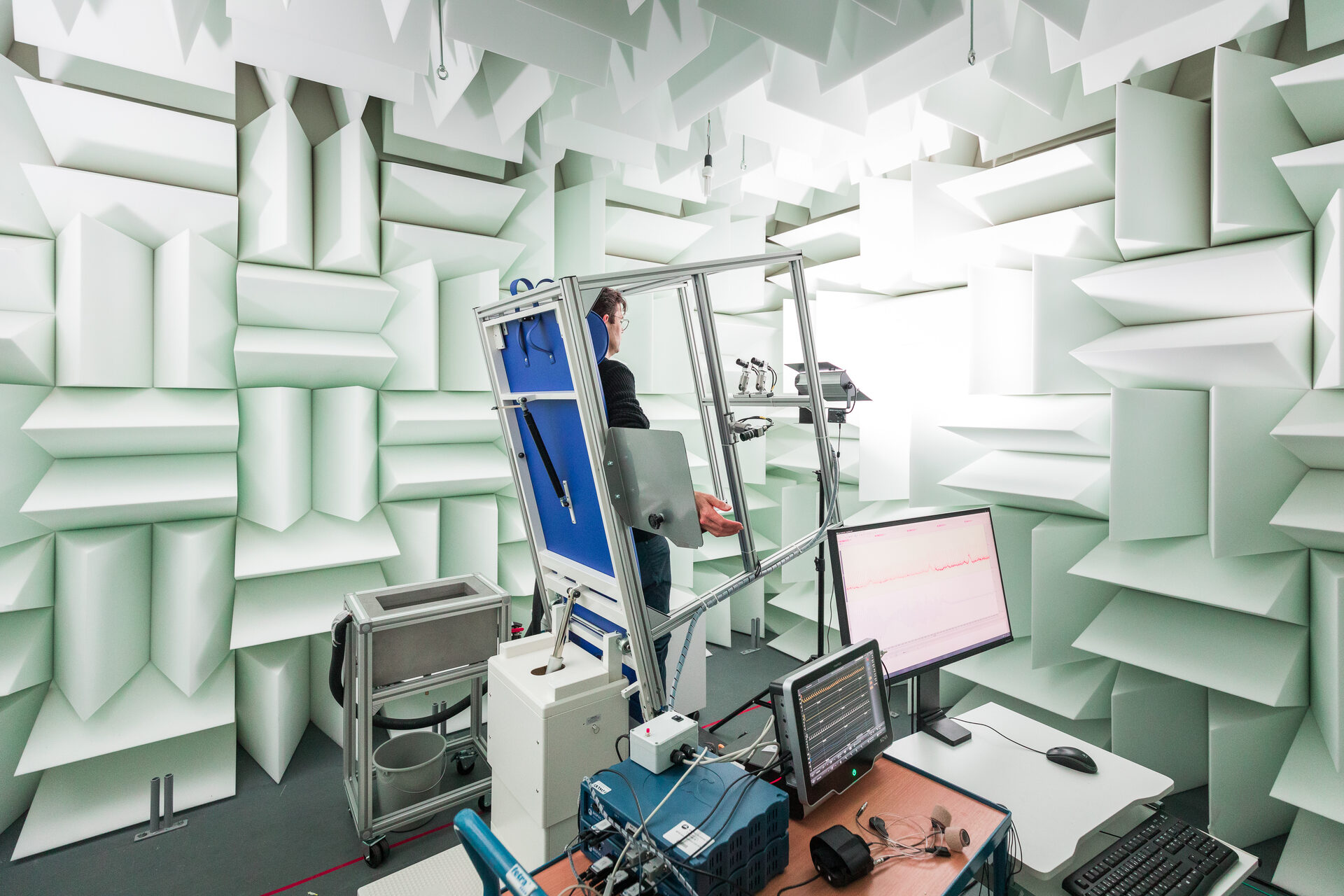
My research focuses on innovative and efficient methods of data acquisition and processing. This includes innovative sensor/measurement technology and aspects from the fields of signal processing, image processing, machine learning methods and modeling/simulation. We, the staff of the Laboratory on advanced measurements and biomedical data analysis (lambda)(Opens in a new tab) and I, combine methods from these areas and develop them further. The aims are
the implementation of innovative diagnostic procedures,
the implementation of clinical support systems and
deepening our understanding of pathophysiological interactions.
Applications lie in a wide range of areas from the clinic to everyday life and sport. A core element here is the intelligent combination of methods from the above-mentioned areas of sensor technology and data processing.
Conventional medical measurement technology is often complex to use, requires contact with the body or is even invasive. Such systems/procedures are stressful for patients and medical staff and are sometimes significantly limited in their applicability.
Own work
We design, develop and validate user-friendly measurement technology, whereby hardware / sensor principles and data processing are considered together. One focus is on the use of cameras, i.e. the acquisition of various vital parameters from video recordings. However, alternatives, e.g. the use of radar or capacitive ECG as well as multimodal concepts, are also being pursued. The implementation and use of wearables also plays an important role. Applications are in clinical and non-clinical monitoring, whereby various clinical pictures (cardiovascular diseases, neurological diseases, depression), use for prevention, ambient assisted living and sport are topics.
Selected own works
S. Zaunseder, A. Henning, D. Wedekind, A. Trumpp, and H. Malberg, "Unobtrusive acquisition of cardiorespiratory signals," Somnologie, vol. 21, no. 2, pp. 93-100, Jun. 2017.
S. Zaunseder, A. Trumpp, D. Wedekind, and H. Malberg, "Cardiovascular assessment by imaging photoplethysmography - a review," Biomed. Eng. / Biomed. Tech, vol. 63, no. 5, pp. 617-634, Oct. 2018.
A. Woyczyk, V. Fleischhauer, and S. Zaunseder, "Adaptive Gaussian Mixture Model Driven Level Set Segmentation for Remote Pulse Rate Detection," IEEE J. Biomed. Heal. informatics, vol. 25, no. 5, pp. 1361-1372, May 2021.
Artificial intelligence for medicine
Background
Artificial intelligence (AI) methods and machine learning in particular are playing an increasingly important role in medicine. They have immense potential to utilize the increasing amount of available data for more efficient diagnostic and therapeutic procedures. Unlike in other AI applications, however, it is not just "content performance" that plays a decisive role with regard to medical use, but also factors such as interpretability, individualization and approval issues.
Own priorities
We deal with the use and further development of artificial intelligence methods in various contexts in order to improve medical care. One focus is on the above-mentioned aspects of interpretability, individualization and approval issues. Our own work covers feature extraction, selection and classification/clustering, whereby AI methods are used and further developed. Specific examples include the automated evaluation of sleep phases, therapy recommendation systems and the early detection or even prediction of medical emergencies. The company's own developments in the field of AI are also incorporated into its own measurement technology.
Selected own works
M. Scherpf, F. Gräßer, H. Malberg, and S. Zaunseder, "Predicting sepsis with a recurrent neural network using the MIMIC III database," Comput. Biol. Med, vol. 113, no. June, p. 103395, Oct. 2019.
M. Goldammer, S. Zaunseder, M. D. Brandt, H. Malberg, and F. Gräßer, "Investigation of automated sleep staging from cardiorespiratory signals regarding clinical applicability and robustness," Biomed. Signal Process. Control, vol. 71, no. August 2021, p. 103047, Jan. 2022.
F. Gräßer, F. Tesch, J. Schmitt, S. Abraham, H. Malberg, and S. Zaunseder, "A pharmaceutical therapy recommender system enabling shared decision-making," User Model. User-adapt. Interact, no. 0123456789, Aug. 2021.
Modeling and simulation can make a significant contribution to the understanding of (patho-)physiological processes and form a basis for the development of new measurement techniques (model-based development).
Own priorities
Various of his own works deal with modeling and combine medical background knowledge with technical solutions. His own work focuses on the interaction of light and tissue, the modeling of the cardiovascular system and the modeling of biosignals of various origins. The work serves to deepen the understanding of fundamental relationships and makes a concrete contribution to the development of innovative measurement technology and analysis methods.
Selected own works
J. Behar, F. Andreotti, S. Zaunseder, Q. Li, J. Oster, and G. D. Clifford, "An ECG simulator for generating maternal-foetal activity mixtures on abdominal ECG recordings," Physiol. Meas., vol. 35, no. 8, pp. 1537-1550, Jul. 2014.
V. Fleischhauer, N. Ruprecht, M. Sorelli, L. Bocchi, and S. Zaunseder, "Pulse decomposition analysis in photoplethysmography imaging," Physiol. Meas., vol. 41, no. 9, p. 095009, Oct. 2020.
Publications
Monograph
G. A. Urban, K. Becker, M. Braecklein, B. Habenstein, P. Knaup, A. Melzer, T. Stieglitz, G. Urban, and S. Zaunseder, Technologische Souveränität in der Biomedizinischen Technik - der Mensch im Fokus. Frankfurt am Main: VDE Verband der Elektrotechnik Elektronik Informationstechnik, 2021 [Online]. Available: https://www.vde.com/resource/blob/2094018/797483bfeea2238c6d59c0d2cc01db15/positionspapier-data.pdf
V. Fleischhauer, J. Adrians, and S. Zaunseder, “Validation of Skin Perfusion Monitoring by Imaging PPG versus Laser Speckle Imaging,” in Proceedings of the 57th Annual Meeting of the German Society of Biomedical Engineering, 2023, pp. 351–354.
A. Woyczyk, S. Rasche, and S. Zaunseder, “Impact of Sympathetic Activation in Imaging Photoplethysmography,” in 2019 IEEE/CVF International Conference on Computer Vision Workshop, 2019, pp. 1697–1705.
V. Fleischhauer, J. Bruhn, S. Rasche, and S. Zaunseder, “Photoplethysmography upon cold stress - impact of measurement site and acquisition mode,” Frontiers in Physiology, 2023.
V. Fleischhauer, A. Feldheiser, and S. Zaunseder, “Beat-to-Beat Blood Pressure Estimation by Photoplethysmography and Its Interpretation,” Sensors, vol. 22, no. 18, 2022.
S. Zaunseder, A. Vehkaoja, V. Fleischhauer, and C. Hoog Antink, “Signal-to-noise ratio is more important than sampling rate in beat-to-beat interval estimation from optical sensors,” Biomedical Signal Processing and Control, vol. 74, 2022.
A. Woyczyk, V. Fleischhauer, and S. Zaunseder, “Adaptive Gaussian mixture model driven level set segmentation for remote pulse rate detection,” IEEE journal of biomedical and health informatics : a publication of the IEEE Engineering in Medicine and Biology Society, vol. 25 (2021), no. 5, pp. 1361–1372, 2021.
F. Gräßer, F. Tesch, J. Schmitt, S. Abraham, H. Malberg, and S. Zaunseder, “A pharmaceutical therapy recommender system enabling shared decision-making,” User modeling and user adapted interaction : umuai ; an international journal, vol. 2021, pp. 1019–1062, 2021.
R. Pape, S. Patzke, S. Zaunseder, and J. Thiem, “Automatic Hypercube Acquisition with high spatial and spectral resolution using a HSI Linescan Camera,” Current Directions in Biomedical Engineering, pp. 811–814, 2021.
A.-G. Pielmus, J. Mühlstef, E. Bresch, M. Glos, C. Jungen, S. Mieke, R. Orglmeister, A. Schulze, B. Stender, V. Voigt, and S. Zaunseder, “Surrogate based continuous noninvasive blood pressure measurement,” Biomedical engineering = Biomedizinische Technik : joint journal of the German Society for Biomedical Engineering in VDE and the Austrian and Swiss Societies for Biomedical Engineering, vol. 66 (2021), no. 3, pp. 231–246, 2021.
V. Fleischhauer, N. Ruprecht, M. Sorelli, L. Bocchi, and S. Zaunseder, “Pulse decomposition analysis in photoplethysmography imaging,” Physiological measurement : an official journal of the Institute of Physics and Engineering in Medicine, representing also the Deutsche Gesellschaft für Medizinische Physik, the European Federation of Organisations for Medical Physics and the International Organization for Medical Physics, vol. 41, no. 9, 2020.
J. A. Behar, C. Liu, K. Kotzen, K. Tsutsui, V. D. A. Corino, J. Singh, M. A. F. Pimentel, P. Warrick, S. Zaunseder, and F. Andreotti, “Remote health diagnosis and monitoring in the time of COVID-19,” Physiological measurement : an official journal of the Institute of Physics and Engineering in Medicine, representing also the Deutsche Gesellschaft für Medizinische Physik, the European Federation of Organisations for Medical Physics and the International Organization for Medical Physics, vol. 41 (2020), no. 10, p. ohne Seitenangabe-ohne Seitenangabe, 2020.
Together with various partners, we are responsible for a number of publications. The following list shows selected works. A more complete overview can be found on ResearchGate(Opens in a new tab), for example.
Selected journal publications
2022
S. Zaunseder, A. Vehkaoja, V. Fleischhauer, and C. Hoog Antink, "Signal-to-noise ratio is more important than sampling rate in beat-to-beat interval estimation from optical sensors," Biomed. Signal Process. Control, vol. 74, no. January, p. Minor Revisions in Progress, 2022.
2021
A. Woyczyk, V. Fleischhauer, and S. Zaunseder, "Adaptive Gaussian Mixture Model Driven Level Set Segmentation for Remote Pulse Rate Detection," IEEE J. Biomed. Heal. informatics, vol. 25, no. 5, pp. 1361-1372, May 2021.
M. Goldammer, S. Zaunseder, M. D. Brandt, H. Malberg, and F. Gräßer, "Investigation of automated sleep staging from cardiorespiratory signals regarding clinical applicability and robustness," Biomed. Signal Process. Control, vol. 71, no. August 2021, p. 103047, Jan. 2022.
F. Gräßer, F. Tesch, J. Schmitt, S. Abraham, H. Malberg, and S. Zaunseder, "A pharmaceutical therapy recommender system enabling shared decision-making," User Model. User-adapt. Interact, no. 0123456789, Aug. 2021.
2020
I. Kukel, A. Trumpp, K. Plötze, A. Rost, S. Zaunseder, K. Matschke, and S. Rasche, "Contact-Free Optical Assessment of Changes in the Chest Wall Perfusion after Coronary Artery Bypass Grafting by Imaging Photoplethysmography," Appl. Sci, vol. 10, no. 18, p. 6537, Sep. 2020.
S. Rasche, R. Huhle, E. Junghans, M. G. de Abreu, Y. Ling, A. Trumpp, and S. Zaunseder, "Association of remote imaging photoplethysmography and cutaneous perfusion in volunteers," Sci. Rep., vol. 10, no. 1, p. 16464, Dec. 2020.
V. Fleischhauer, N. Ruprecht, M. Sorelli, L. Bocchi, and S. Zaunseder, "Pulse decomposition analysis in photoplethysmography imaging," Physiol. Meas., vol. 41, no. 9, p. 095009, Oct. 2020.
J. A. Behar et al, "Remote health diagnosis and monitoring in the time of COVID-19," Physiol. Meas., vol. 41, no. 10, p. 10TR01, Nov. 2020.
2019
M. Schmidt, M. Baumert, T. Penzel, H. Malberg, and S. Zaunseder, "Nocturnal ventricular repolarization lability predicts cardiovascular mortality in the Sleep Heart Health Study," Am. J. Physiol. Circ. Physiol., vol. 316, no. 3, pp. H495-H505, Mar. 2019.
M. Scherpf, F. Gräßer, H. Malberg, and S. Zaunseder, "Predicting sepsis with a recurrent neural network using the MIMIC III database," Comput. Biol. Med, vol. 113, no. June, p. 103395, Oct. 2019.
S. Rasche, A. Trumpp, M. Schmidt, K. Plötze, F. Gätjen, H. Malberg, K. Matschke, M. Rudolf, F. Baum, and S. Zaunseder, "Remote Photoplethysmographic Assessment of the Peripheral Circulation in Critical Care Patients Recovering from Cardiac Surgery," Shock, vol. 52, no. 2, 2019.
2018
S. Zaunseder, A. Trumpp, D. Wedekind, and H. Malberg, "Cardiovascular assessment by imaging photoplethysmography - a review," Biomed. Eng. / Biomed. Tech, vol. 63, no. 5, pp. 617-634, Oct. 2018.
D. Wedekind, D. Kleyko, E. Osipov, H. Malberg, S. Zaunseder, and U. Wiklund, "Robust Methods for Automated Selection of Cardiac Signals After Blind Source Separation," IEEE Trans. Biomed. Eng, vol. 65, no. 10, pp. 2248-2258, Oct. 2018.
A. Trumpp, J. Lohr, D. Wedekind, M. Schmidt, M. Burghardt, A. R. Heller, H. Malberg, and S. Zaunseder, "Camera-based photoplethysmography in an intraoperative setting," Biomed. Eng. Online, vol. 17, no. 1, p. 33, Mar. 2018.
M. Schmidt, M. Baumert, H. Malberg, and S. Zaunseder, "Iterative two-dimensional signal warping-Towards a generalized approach for adaption of one-dimensional signals," Biomed. Signal Process. Control, vol. 43, pp. 311-319, May 2018.
Selected other publications/works
S. Zaunseder and S. Rasche, "Clinical applications for imaging photoplethysmography," in Contactless Vital Signs Monitoring, Elsevier, 2022, pp. 149-164.
A. G. Pielmus, J. Mühlsteff, E. Bresch, M. Glos, C. Jungen, S. Mieke, R. Orglmeister, A. Schulze, B. Stender, V. Voigt, and S. Zaunseder, "VDE Position Paper Surrogate Based Continuous Noninvasive Blood Pressure Measurement," 2020.
Teaching
Overview
My teaching covers aspects from the following areas
(patho-)physiological basics,
medical technology systems,
measurement technology,
data processing and
modeling and simulation.
Teaching takes place in various subjects and teaching formats, often in a combination of theoretical and practical content and tasks.
Current courses
Bachelor's degree
Cardiovascular system
Medical technology systems
Applied Biosignal Processing - beat detection
Applied Biosignal Processing - introduction to machine learning
Practical course 1
Practical course 2
Presentation technology
Seminar Biomedical Engineering
Master
Applied biomedical engineering
Machine Learning
This site uses cookies to ensure the functionality of the website and to collect statistical data. You can object to the statistical collection via the data protection settings (opt-out).