

When children find their own way through the woods, explore life on a farm, or work together to develop solutions in a workshop, they learn far more than just math or German. This is exactly where the “Rethinking Learning” project comes in, which has been opening up new learning spaces in Dortmund since 2022. Scientific monitoring by Fachhochschule Dortmund confirms the positive effects.
The project combines school-based learning with extracurricular learning environments. In 2022–2023, the Dortmund Foundation provided initial funding of 300,000 euros with the help of donations from Dortmund residents and businesses, as well as from Dr. Ausbüttel GmbH & Co. KG. Currently, the City of Dortmund is funding the project through the summer of 2027.
Six elementary schools (mostly from northern Dortmund) and one special education school are participating. Here’s how “Rethinking Learning” works: Once a week, the classes at the participating schools are split up. Half of the class stays at school, while the other half goes out to visit educational farms and take part in nature and cultural activities. The following week, they switch places. The goal is to strengthen the children academically and, above all, in terms of their personal development, self-confidence, and social skills. The students are accompanied by social work students from Fachhochschule Dortmund and student teachers from TU Dortmund University—the so-called “teamers.”
Positive Effects on Social Skills
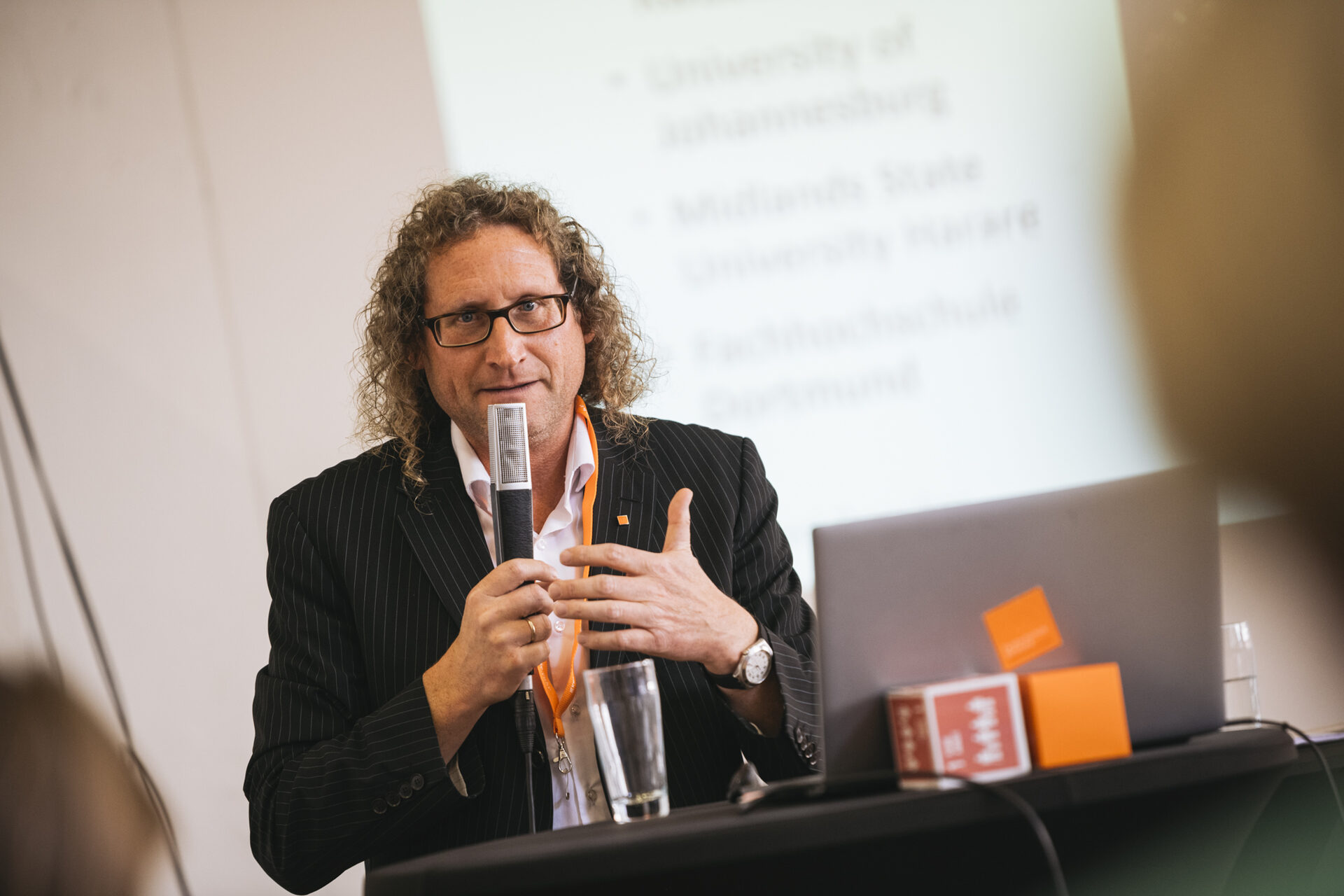
“In extracurricular learning settings, we see particularly strong positive effects on social skills, self-efficacy, and teamwork. These settings foster developmental progress that is often neglected in traditional classroom instruction,” says Prof. Dr. Michael Boecker. He teaches in the Faculty of Applied Social Studies at the Fachhochschule Dortmund and is overseeing the project together with research assistants Sina-Marie Levenig and Dorothée Boecker. To this end, the university’s researchers observe the children both at school and at out-of-school learning settings and regularly speak with teachers and educators.
Progress is particularly evident in language development, conflict resolution, motivation to learn, and participation. “The project shows how important learning environments outside the classroom are for educational equity. Especially for children with different starting conditions, it opens up new avenues for learning,” says Dr. Anja Jungermann, director of the City of Dortmund’s Regional Education Office. There, the project is coordinated in collaboration with the association Stadtteil-Schule Dortmund. The two co-initiators and school principals, Christiane Mika (Libellen Elementary School) and Alma Tamborini (Nordmarkt Elementary School), also confirm the project’s success, which they observe in their students every day. Alma Tamborini: “Half of the students who stay at school work and learn much more effectively. In a single class period with half the class, we accomplish as much as we normally would with the entire class over three days.”
Educational Value
“The project has the potential to have an impact far beyond individual classes. It transforms the school as a system when we permanently embed such approaches,” says Prof. Boecker. He is convinced. “The money for ‘Rethinking Learning’ is very well spent. The educational value is enormous.” The project reaches its full potential where schools, teachers, and team members collaborate closely. His hope is for long-term structural support so that this model can benefit many schools in North Rhine-Westphalia.
The current scientific monitoring of “Rethinking Learning” in Dortmund, funded by Dr. Ausbüttel GmbH & Co. KG, will continue through the end of the year. And even though the final scientific evaluation is still pending, the trend is clear; the benefits are obvious. “That’s why we’re currently exploring all options to continue the project in the coming years,” says Anja Jungermann.
In addition to the elementary school students, students at Dortmund’s universities of applied sciences and technical universities will also benefit from this. Currently, about fifty of them are working on the project. As team members, they gain valuable initial professional experience in an exciting environment and, at the same time, serve as relatable educational role models for the elementary school students.