


About 160 freshmen in the Faculty of Business Studies took on a team challenge together. This pilot workshop format is part of the faculty’s new onboarding program.
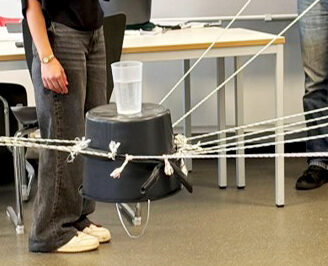
The task: Transport a glass of water from a circular area without stepping inside the circle, touching the glass, or spilling anything. Permitted tools include six strings, a bicycle inner tube, and a pair of scissors.
An added challenge: The team is divided into “operators,” “supervisors,” and “directors.” Only the former are allowed to actively participate in retrieving the glass—but they must do so blindfolded and wearing work gloves. The others can only give them instructions. Time limit: 45 minutes.
Ideas Through Teamwork
The idea for this event, part of the “Sustainability and Self-Reflection” module in the Bachelor’s study program in Business Administration, came from Prof. Dr. Hanaa Ryari. She was supported in the planning and implementation by Miriam Klappert, a licensed psychologist; Ursula Moll, an external trainer, systemic organizational developer, and Gestalt therapist; and the teaching assistants Hevie Cheikho and Diar Karim.
The goal was to provide students with a shared learning and reflective experience right at the start of their studies. At the same time, they were able to familiarize themselves with their fellow students, the faculty, and everyday university life, while honing skills such as teamwork and communication.
The hose in the middle
Eight teams, each with about 20 freshmen, tried their luck. They all came up with a similar approach: They folded the bicycle tube in half and tied four strings to it so that two were on the top loop and two on the bottom loop, facing each other. This allowed them to maneuver the tube while keeping it suspended, as well as pull the strings to tighten it and thus grasp the glass.
The focus wasn’t on whether the challenge was ultimately solved successfully. Rather, the demanding task gave the students the opportunity to directly experience their own behavior and the dynamics within a larger group. Who takes responsibility? How do ideas and decisions emerge? Are all group members included? How does the group deal with differing suggestions, uncertainty, and time pressure? And what happens if the initially chosen solution does not lead to the desired result?
Valuable Self-Reflection
These experiences formed the basis for the subsequent self-reflection. The students examined their own roles, communication within the group, and their collaborative approach. In doing so, they were able to reflect on what had worked well, where difficulties had arisen, and what they would do differently if they were to repeat the activity.
In addition to the fun and shared experience, the learning process was thus at the forefront. The challenge allowed students to directly experience communication, collaboration, role behavior, and decision-making processes, thereby creating concrete points of reference for applying these insights to their own studies.