

Trucks that weigh their own loads and report potholes: What sounds futuristic has become reality at Dortmund University of Applied Sciences and Arts. In the "CargoTrailSense_AI" research project, a team led by Prof. Dr. Yves Rosefort has developed an innovative sensor solution that not only speeds up logistics processes, but can also relieve the burden on road construction.
The project, funded by the Federal Ministry of Transport (BMV), is now delivering promising data at the end of the project, which has already aroused the interest of the Federal Office for Roads and Traffic.
Trucks are the backbone of goods transportation and ensure that industry, trade and supply function on a daily basis. To ensure that transport chains remain efficient, safe and infrastructure-friendly, precise information is required - for example on the loading situation, axle load and stresses en route. This is precisely where the "CargoTrailSense_AI" research project comes in. A team from the Faculty of Mechanical Engineering equipped truck trailers with a combination of strain gauges, acceleration sensors and intelligent evaluation software to transform the trailer into a moving measurement laboratory. In collaboration with several haulage companies and project partner ContiTech, new air suspension pads with integrated sensors were also installed in various trailer models and tested on different routes in real-life operation in order to create a broad database.
Precise data instead of waiting times at the scales
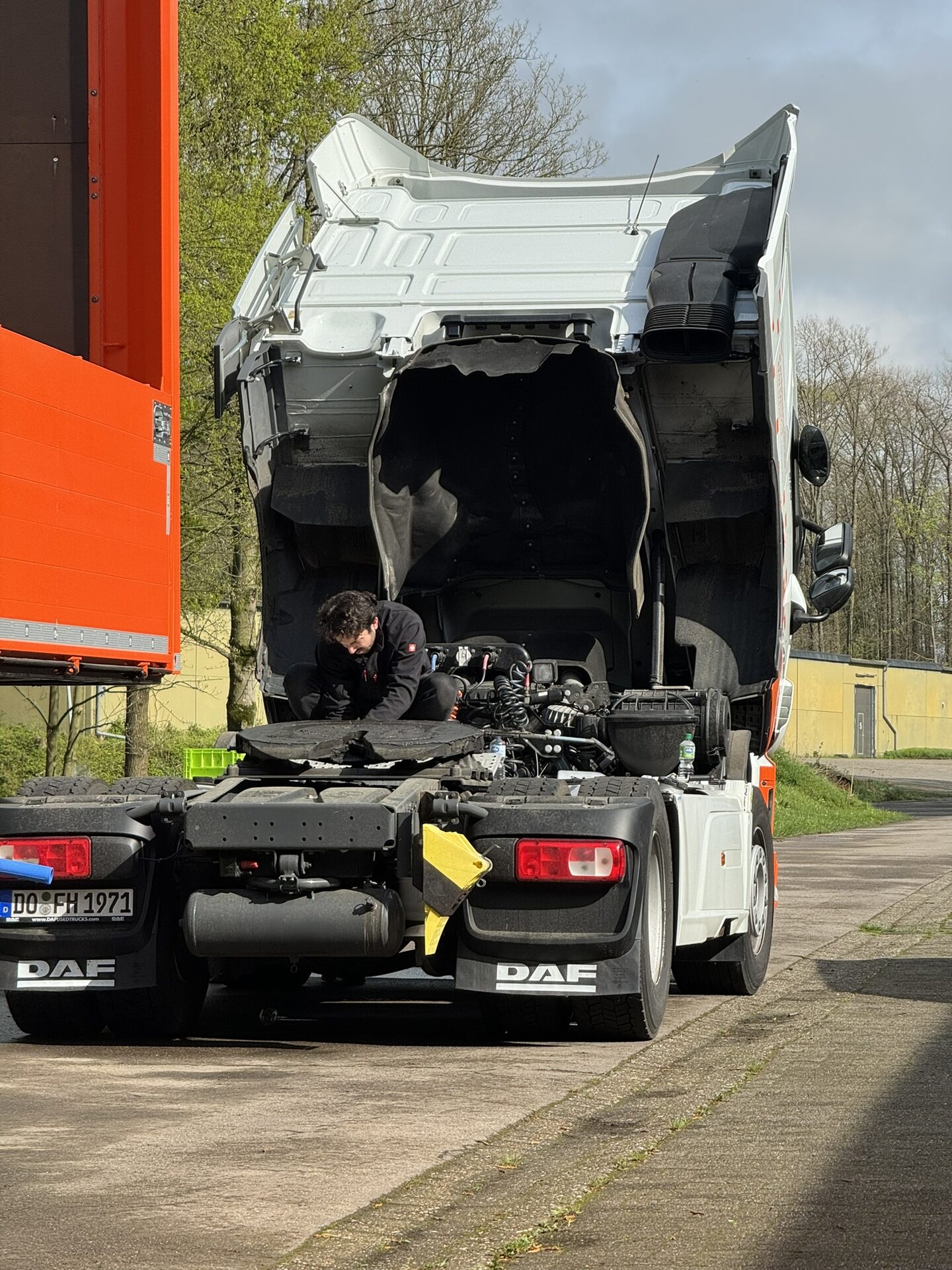
The results show the enormous potential of the technology: the sensors achieve a very high level of accuracy when determining the load distribution. In the calibrated trailer, the deviation from the scales was less than one percent. This can be a decisive economic factor for haulage companies, as waiting times at stationary weighing facilities would be eliminated and the load distribution would be continuously monitored during the journey. Overloading - and the associated fines - can thus be effectively prevented. At the same time, the system enables predictive maintenance, as wear on the tires or defects in the brakes are detected at an early stage by changes in the sensor data.
"With this project, we have shown that a highly complex but extremely powerful system is possible by combining various sensors and sophisticated technology on the truck trailer," sums up Prof. Dr. Yves Rosefort, who led the project at Fachhochschule Dortmund.
Trucks as "road scanners"
maintaining the infrastructure," explains Marius Jones, research assistant in the project team at the UAS. The Federal Office for Roads and Transportation (BASt) has already expressed interest in the research data in order to examine projects based on it. Marius Jones sees the technology as a necessary step for the future of freight transport. "Sooner or later, this type of sensor technology will have to be installed in trucks as standard," he is convinced.
Despite the technical successes, there is still a lot to do before it is ready for series production and market launch. For haulage companies and manufacturers to install the system as standard, it needs to become even cheaper. After all, the logistics market is highly competitive, meaning that just a few hundred euros in additional costs can make all the difference. The researchers are therefore also discussing new financing approaches: Toll discounts for haulage companies that use such a system and make the condition data obtained available to the general public would be conceivable, for example. After all, inefficiently loaded trailers and unnecessary downtimes are already causing high economic losses today, which could be avoided with this intelligent technology.