

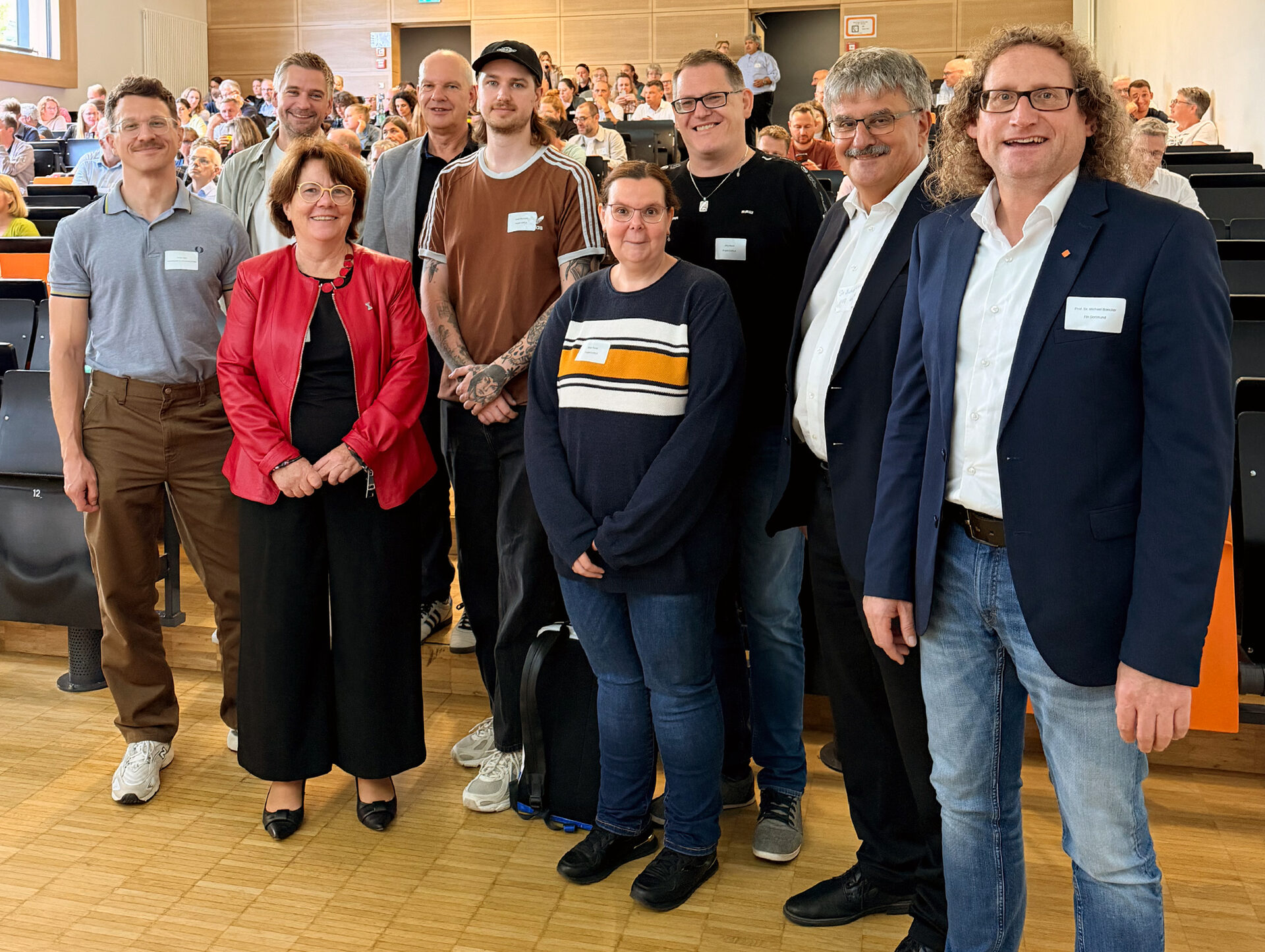
An Opportunity for Greater Participation and an Honest Look at Processes: On September 8, 2026, more than 200 experts from academia, the social sector, and service providers gathered at Fachhochschule Dortmund to discuss the use of artificial intelligence (AI) in integration assistance.
Can AI help people with disabilities achieve greater self-determination? In what ways does it ease the daily workload of social workers? In which areas does this shift require a fundamental rethinking of practice, administration, and training? At the symposium “AI in Integration Support” at Fachhochschule Dortmund, it became clear that AI offers enormous opportunities for barrier-free communication and streamlined procedures, while at the same time ruthlessly exposing where analog processes and data structures have failed in the past. At the same time, algorithmic assessments also pose a risk.
The regular symposium at the Faculty of Applied Social Studies is organized in cooperation with the State Working Group for Workshops for People with Disabilities and the Center for Special Education in Krefeld/Viersen District.
From translation tools to the digital application system
The range of concrete AI applications in integration assistance is already considerable today. In one of the keynote presentations, the KARLA project (developed in collaboration with TU Dortmund University, among others) introduced an AI-powered application that automatically translates official letters—which are often difficult to understand—into plain or simple language. The goal is to enable people to participate in society on their own terms without constant assistance from others.
Several specialized workshops then explored practical initiatives in greater depth:
- Paritätische NRW presented IANOS, a comprehensive platform featuring intelligent assistants designed to reduce the administrative burden on staff at care facilities.
- Thomas Haberl from the Rhineland Regional Council (LVR) explained the use of AI-powered assistance systems in assessing support needs and processing benefit applications.
Numerous other examples were discussed. “However, technology does not improve poor analog processes,” emphasized Prof. Dr. Sabine Sachweh from the Institute for the Digital Transformation of Application and Living Domains at Fachhochschule Dortmund during the concluding panel discussion. “We must carefully examine how and where we use technology, what the specific risks are, and where there is a real benefit,” Brigitta Neumann, partner and member of the executive board at “contec,” also cautioned. She noted that companies and organizations need a clear strategic direction rather than unstructured individual initiatives.
“Perhaps the greatest opportunity lies in the fact that AI ruthlessly exposes where things haven’t been working in organizations so far,” explained Maximilian Weiß, specialist advisor for digitalization and transformation at Paritätische NRW. “If we don’t turn a blind eye to this, that in itself is a tremendous step forward.”
At the same time, warnings were issued: If algorithms are used to describe or approve services in a blanket manner, there is a risk that individual cases will get lost in “digital boxes.” “Artificial intelligence can provide enormous support in data processing or accessibility, but ethical evaluation and pedagogical decisions must always remain in the hands of professionals,” emphasized Dr. Michael Weber, Executive Director of the Special Education Center Krefeld/Viersen District, during the discussion.
Implications for Education and Science
This development has implications for academia and universities. Computer science professor Sabine Sachweh emphasized the need for transformation in higher education as well. “Until now, we’ve taken a very broad approach to education in computer science. But in the future, graduates will no longer need to master many programming languages.” What is more important, she said, is a fundamental technical and procedural understanding, the ability to assess the impacts of technology, and ethical judgment: What is appropriate, what is good, and where do the dangers lie?
Prof. Dr. Michael Boecker concluded by underscoring the integrative necessity of inter- and transdisciplinarity: “AI is forcing us in academia to look beyond our own horizons. We must directly involve those affected and the target groups in the development of systems from the very beginning. Only in this way can we ensure that AI serves as a tool for accessibility, social justice, and human coexistence.”