

Several student teams developed new components for the “Nuevo35” research vehicle during the summer semester. These components make the prototype more sustainable, efficient, and safer.
This research project combines hands-on learning with sustainable mobility: Since 2020, the “Nuevo35” has been continuously refined and brought closer to perfection by rotating teams of students at Fachhochschule Dortmund.
The electric vehicle is designed to achieve an extremely low CO₂ footprint of 35 grams per kilometer driven—with production, electricity, fuel, and disposal already factored in.
The project is divided into several subprojects that address different areas of vehicle development.
Powertrain
The Powertrain Team is responsible for all components that generate energy and thereby power the vehicle. It focuses not only on the efficient use of electrical energy for propulsion, but also on recovering kinetic energy during braking. The team succeeded in making the control unit architecture—that is, the entirety of the hardware and software—more streamlined and secure.
The students migrated the one-pedal drive—which was designed in the previous semester and is used to both accelerate and brake the vehicle—from an Arduino-based solution to a more powerful ESP32 platform. To do this, they developed hardware prototypes, set up communication between the control units, and analyzed the CAN interfaces.
In addition, they implemented a new steering architecture and performed a kinematic analysis to ensure that the vehicle stays on course when cornering, designed sensor mounts, and integrated the sensor systems for future autonomous driving functions.
Vehicle electronics
The automotive electronics technicians advanced the vehicle's electrical architecture. They implemented and tested a program for the controlled operation of the electric motors and integrated protection for the electrical system.
In addition, they systematized the documentation of the vehicle’s wiring and have already mapped out one-third of all the vehicle’s electrical connections, which will greatly simplify future developments.
Experiment
During the summer semester, the Test Team focused on troubleshooting to restore the car’s roadworthiness. The team designed a new firewall and relocated the 12-volt starter battery to the rear of the car, where it is more easily accessible and simplifies the installation of future components.
In addition, the students laid the groundwork for operating the roller dynamometer, prepared for further driving tests, and evaluated the results.
NFK Center Console
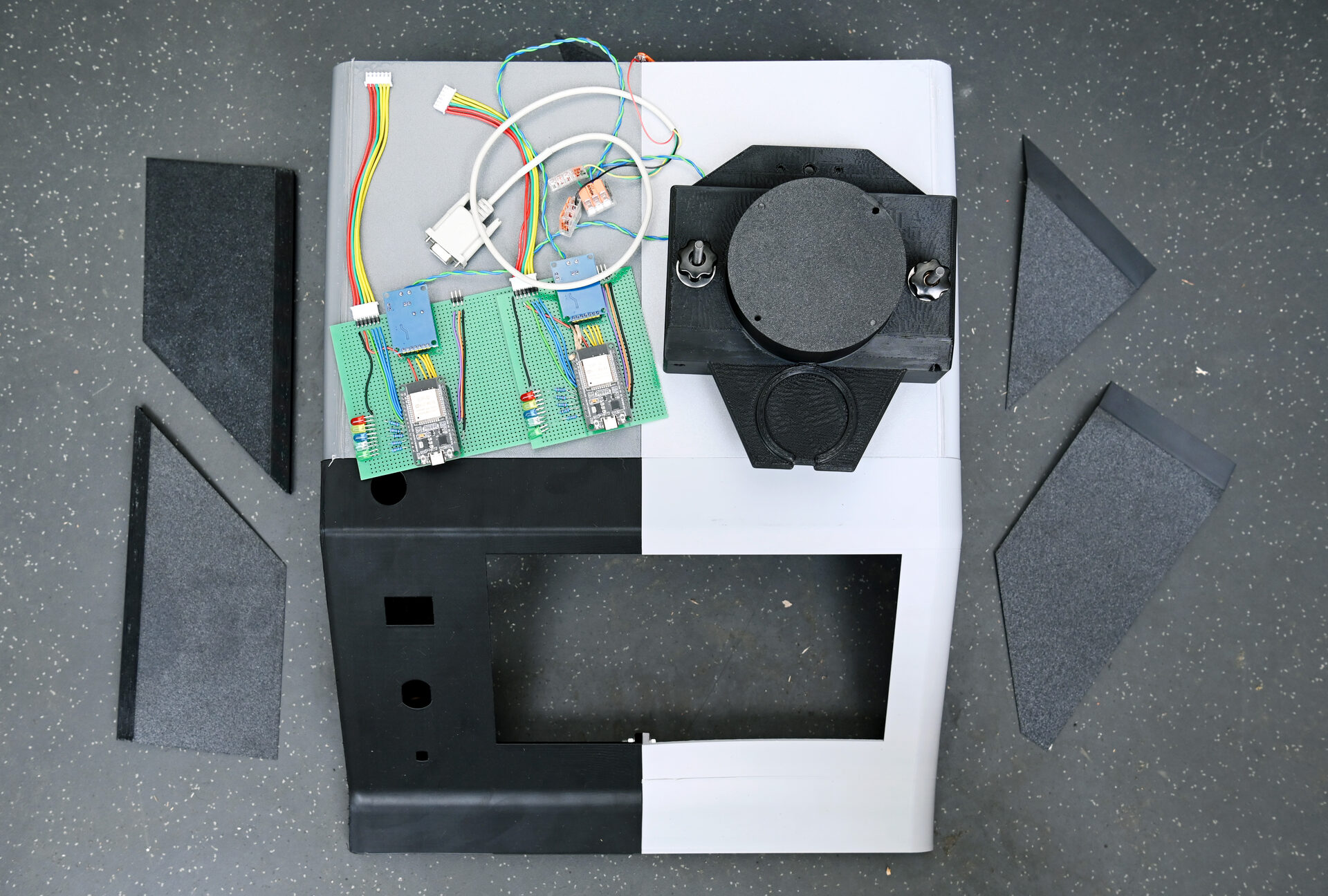
NFK stands for natural fiber-reinforced plastic. The NFK Center Console team is using this material to develop a sustainable version of this component. The students further refined the concept they developed last semester. The goal is a lightweight, sustainable, and functional center console that can then be integrated into the test vehicle.
The Parties Involved
- Powertrain Team: Team Leader (TL) Assia Izri, Zulaika Zahir, Ahmad bin Zakaria, Samwail Akhnounh, Siham Ayad, Hasan Eid, Abdulrahman Al Sebaei, May Gad, Ilkay Gökdemir, Fatih Ovali, and Ulas Akkaya.
- Vehicle Electronics Team: Jessica Pilch (Team Leader) and Angelo Sapina.
- Testing Team: Sönke Bengtsson (TL), Irfan Gunawan, Felix Schröder, Marouane Laaouichi, Hamza Yousafi, and Magdy Ahmed.
- Center Console Team: Christopher Berg (Team Leader), Andre Hämmeling, and Yacine Ahmad Aiad.
- The mentors are Prof. Dr. Vinod Rajamani, Stephan Gotlieb, and Pavan Shetty. The project manager is Mohamed Guerami.