
Diverse, labor-intensive, international, enriching! That’s how the ORCAthon 2026 can be summed up. On September 14 and 15, 2026, 25 international lecturers gathered at Fachhochschule Dortmund to collaboratively adapt digital teaching materials and create modules as Open Educational Resources (OER).
From the Idea to OER Modules
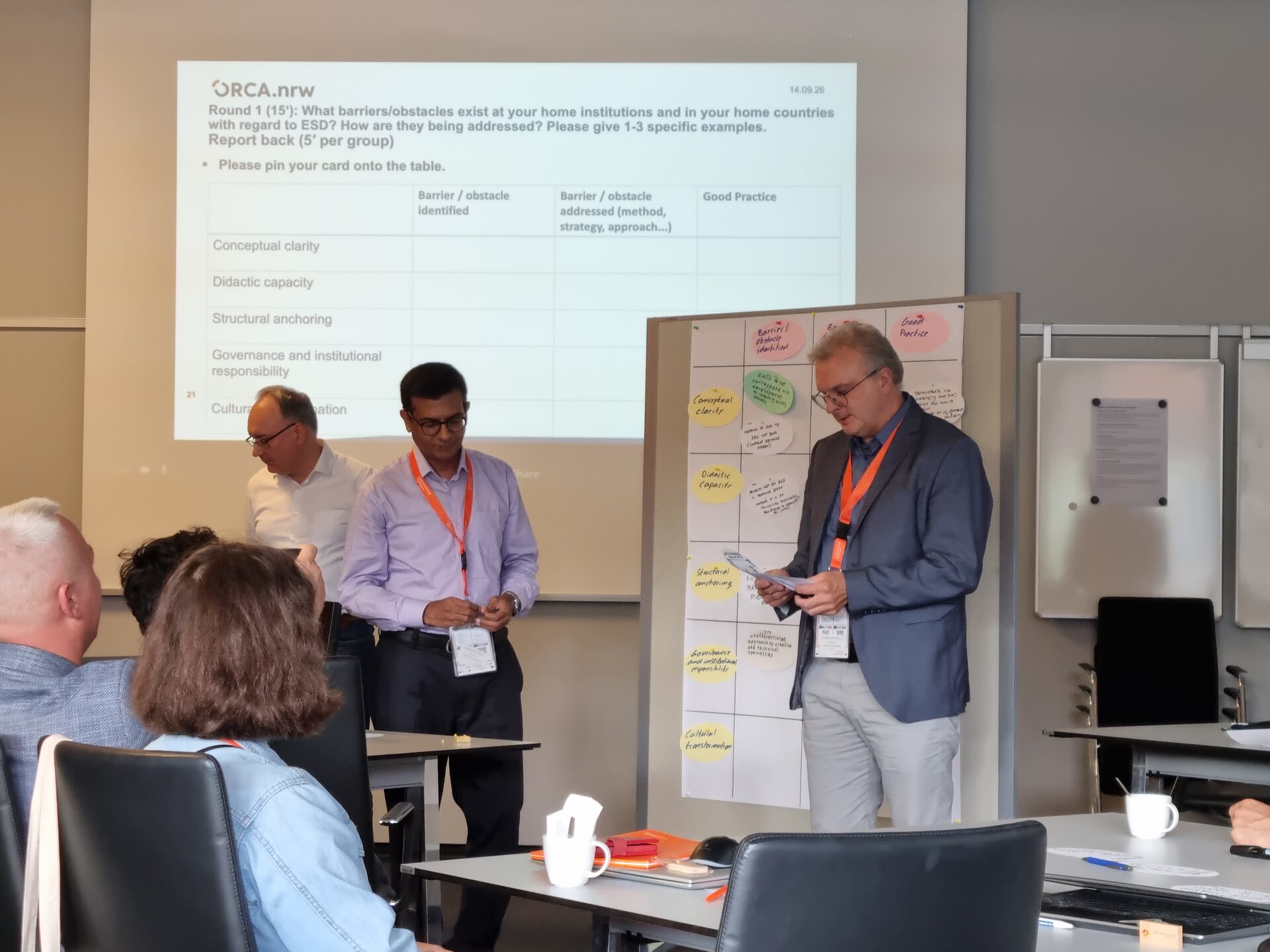
The ORCAthon began with opening remarks by Markus Deimann, Managing Director of ORCA.nrw, and Vice Rector Stephan Weyers, who is responsible for academic affairs, teaching, and international relations at Fachhochschule Dortmund. Both emphasized the importance of digital sustainability and international cooperation in everyday university life. Sebastian Kreimer (CSR) and Rebecca Hegemann-Rockel (Bibliothek⁺) then introduced the topic of “Digital Sustainability.”
The participants then began with a workshop: “Sustainability in the Disciplines – Integrating ESD (Education for Sustainable Development) into Subject-Based Curricula in Higher Education” was the topic that Markus Deimann and Joachim Preusse from ORCA.nrw had prepared for this session. Lara Trompeter from the Legal Information Center at FernUniversität Hagen explained the basics of European copyright law, particularly with regard to Creative Commons licenses.
Work and Creativity in International Teams
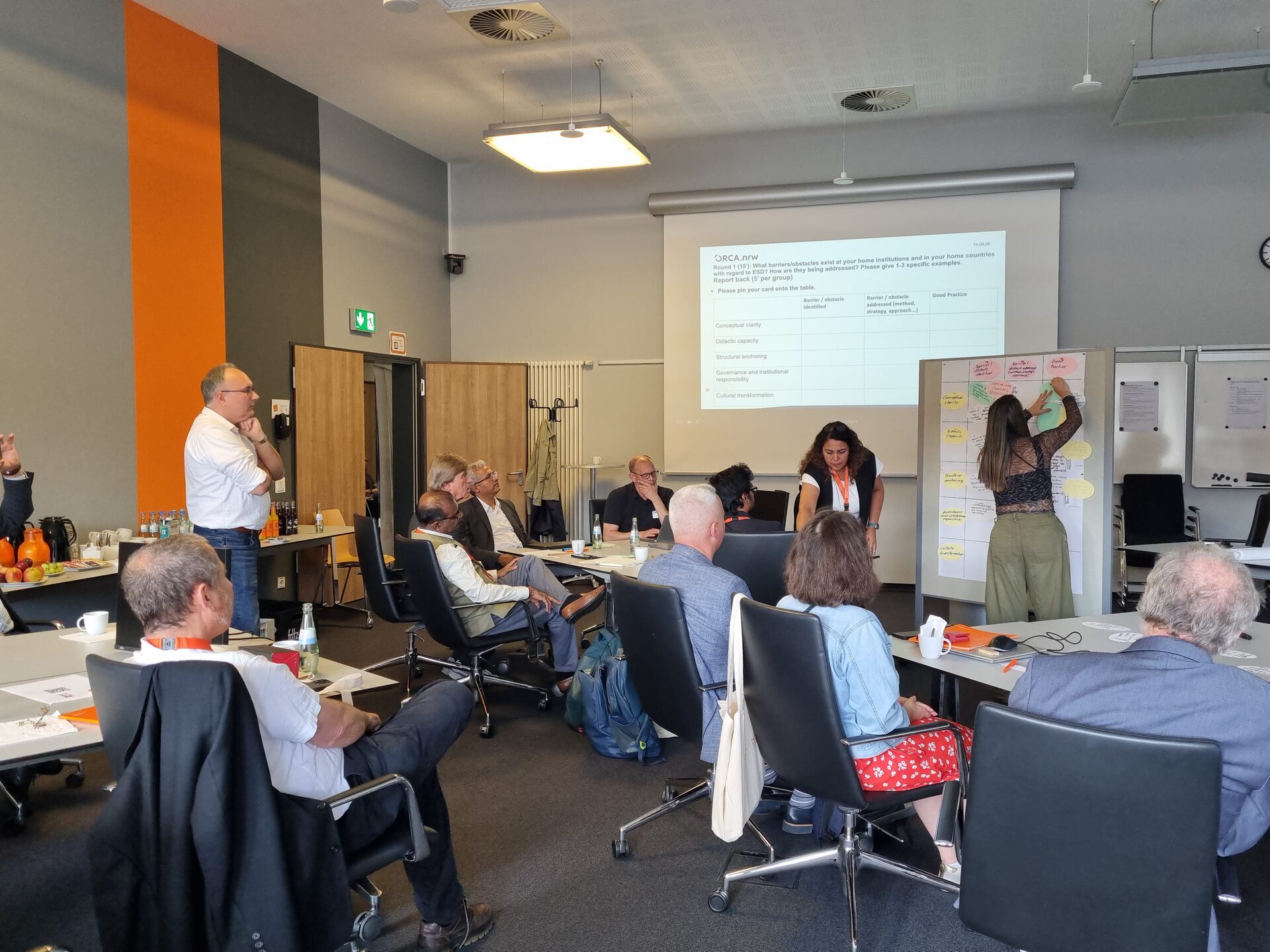
Armed with this in-depth information, the participants worked in internationally diverse teams. These teams had already been formed online in the run-up to the ORCAthon and had defined topics for new modules in the field of project management. During the in-person session at Fachhochschule Dortmund, they worked on the concrete implementation.
Their work was supported by expert counseling: Vincent Beringhoff (instructional videos and media-didactic concepts), Sebastian Kreimer (sustainability), and Wolfgang Schmidt-Sielex and Christian Schnieders (accessibility of instructional materials) were on site. They contributed their expertise to support the quality, methodological diversity, and accessibility of the OER materials.
Practical Experience for Students, Too
Alongside the lecturers, international student groups from project management study programs also worked on innovative, self-selected projects—having already been engaging in virtual collaboration for several weeks. At the end of the ORCAthon, they were invited online to Dortmund and presented their results to a jury.
“Those were two days of intensive academic exchange, but also time for discussions about teaching and learning cultures around the world. Making international educational cooperation as tangible as it was here at the ORCAthon is a truly valuable experience for us as lecturers, but also for the students,” says Carsten Wolff from IDiAL.
The ORCAthon was organized by ORCA.nrw, Bibliothek⁺, and IDiAL (both at Fachhochschule Dortmund and Arts) and was part of the International Summer Convention.